
Perpetual Contracts: Product Structure and Recent U.S. Regulatory Developments
This update, the first in a series, explains what Perpetuals are and how they work, and traces recent relevant regulatory developments in the U.S.
Key Takeaways
- Perpetual contracts are derivative contracts with no fixed expiration or maturity date that rely on a periodic funding rate mechanism to maintain alignment between the contract’s price and the price of the underlying asset.
- Long a fixture of offshore digital asset markets, Perpetuals have begun trading on CFTC-regulated exchanges following the CFTC’s May 29, 2026 order approving the first U.S. Perpetual and an accompanying policy statement.
- Additional U.S. listings have followed quickly, while Perpetuals referencing asset classes beyond certain digital commodities remain subject to case-by-case CFTC review.
- The U.S. regulatory regime that applies to a particular Perpetual depends on how the product is classified under existing federal statutes. The CFTC and the SEC have jointly requested public comment on the application of those definitions to innovative products, including Perpetuals. This alert does not address how Perpetuals referencing different underlying assets should be classified.
Perpetual contracts (Perpetuals), long a fixture of offshore digital asset markets, have made their debut in regulated U.S. markets thanks to recent action by the Commodity Futures Trading Commission (the CFTC).
This alert, the first in a series, explains what Perpetuals are and how they work, and traces recent relevant regulatory developments in the U.S. As outlined below, Perpetuals are innovative financial products for which global market demand is significant and rapidly expanding. The U.S. regulatory framework that will govern Perpetuals is still taking shape. Future publications in this series will address specific legal, regulatory and market structure issues relating to Perpetuals in greater depth.
II. What Is a Perpetual?
A. Definition
A Perpetual is a derivative contract. Like many derivatives, Perpetuals provide economic exposure to the price movement of an underlying asset. In contrast to other derivative contracts with a fixed expiration or maturity date, Perpetuals have an indefinite term.
Perpetuals rely on a periodic funding rate mechanism to maintain relative parity with the underlying asset’s spot price, whereas the price of a traditional futures contract converges with the spot price of its underlying on the expiration date.
Perpetuals may also be available to trade on a 24/7 basis where the rules and operational framework of the exchange on which they are listed permit. Although 24/7 trading is not inherent to Perpetuals, it is a common feature, particularly with respect to Perpetuals that reference an underlying that trades around the clock, such as most digital assets. Perpetuals also allow traders to take on greater exposure by using leverage, subject to any margining, clearing, risk management and customer protection requirements imposed by regulators, the relevant market and the trading venue.
B. Funding Rate
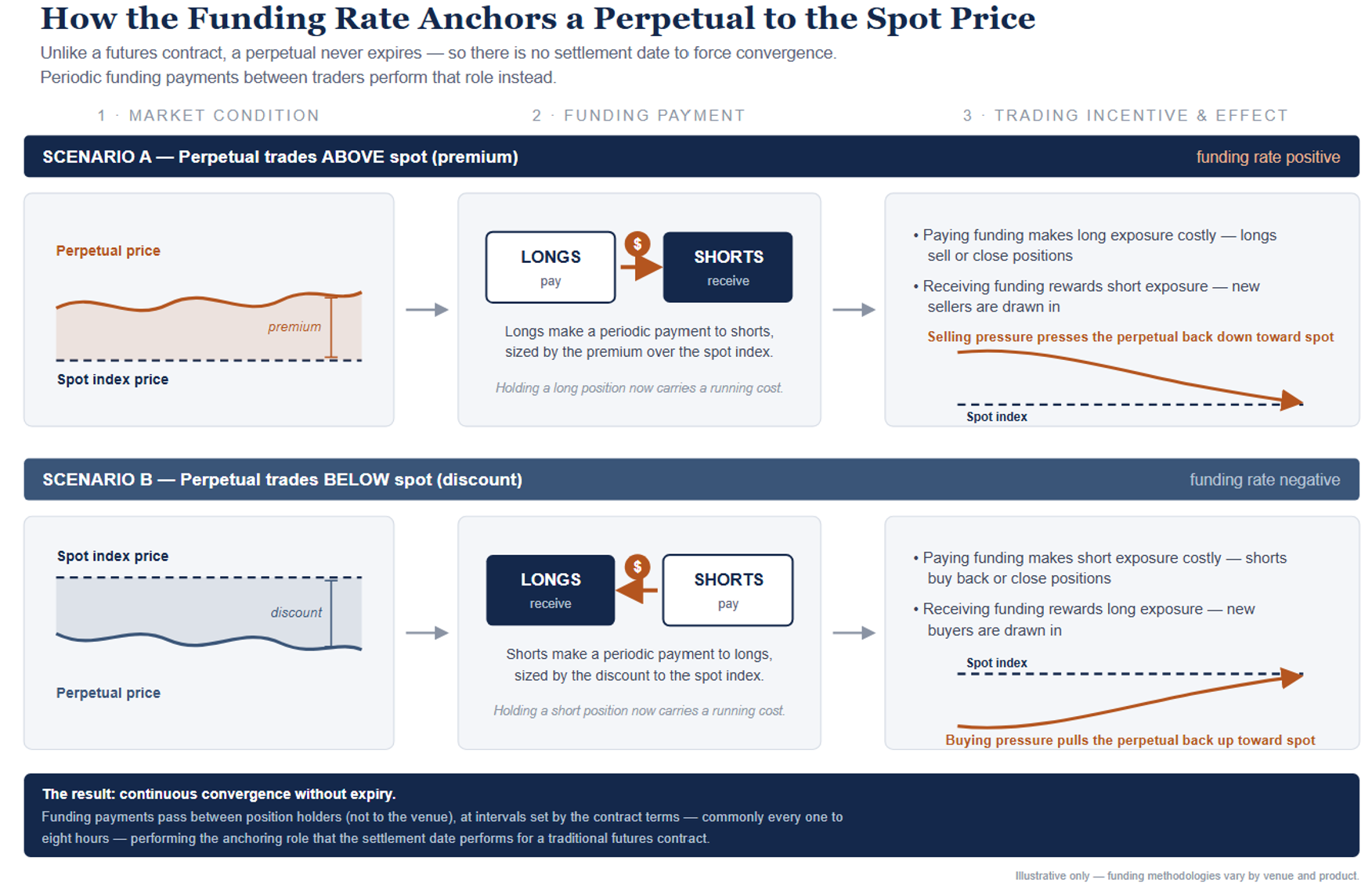
The funding rate is a periodic payment between long and short position holders, calculated and paid on a schedule set by contract terms. The funding rate is based generally on the difference between the Perpetual’s price and the spot price of the underlying asset. The methodology for calculating the funding rate is set by the listing venue and is typically published in the contract specifications for each product rather than kept proprietary. Although the precise formula varies by venue and by product, it generally includes a premium or discount component that measures the divergence of the Perpetual’s price, often calculated on a time-weighted average basis, from a spot index for the underlying asset and, on some venues, an interest rate component. Funding intervals also vary by venue and product, with payments commonly exchanged at one-hour to eight-hour intervals.[1] When the Perpetual trades above the spot price, the long position pays the short position an amount determined by the funding rate. Conversely, when the Perpetual trades below the spot price, the short position pays the long position the funding rate payment.
In a traditional futures contract, convergence with the spot price of the underlying occurs at expiration of the contract. By contrast, because a Perpetual has no expiration date, its funding rate is designed to promote alignment between the price of the Perpetual and the price of the underlying asset. When the Perpetual trades below the spot price, traders have an incentive to buy the Perpetual to receive the periodic payments determined by the funding rate, driving the price of the Perpetual up toward the spot price. The opposite occurs when the price of the Perpetual exceeds the spot price: payments to the short position incentivize selling the Perpetual, moving the price downwards.
 |
C. Origins and Trading Venues
The concept of a derivative contract without a fixed expiration date was proposed in academic literature in the early 1990s,[2] but Perpetuals achieved commercial prominence in digital asset markets beginning in 2016, when offshore digital asset exchanges introduced Perpetuals where the underlying asset referenced was bitcoin. Perpetuals have since become among the most actively traded instruments in global digital asset markets, and trading venues have expanded the product to reference other underlyings, including other digital assets, precious metals, foreign exchange, equity indexes, single equities and the implied valuations of certain private companies.
Perpetuals currently trade on several distinct types of venues. Offshore centralized exchanges have historically accounted for the substantial majority of global trading volume in Perpetuals and operate outside the U.S. regulatory framework, subject to the licensing regimes of their home jurisdictions. Perpetuals are also listed on decentralized, or onchain, trading protocols, which execute trades and administer margin, funding payments and liquidations through smart contracts rather than through a centralized exchange operator. Most recently, as discussed in Section III below, certain Perpetuals referencing digital commodities, such as bitcoin and ether, have been listed on CFTC-registered designated contract markets (DCMs) and cleared through CFTC-registered derivatives clearing organizations (DCOs). The availability and design of the risk controls described below, and the regulatory requirements applicable to them, vary depending on the type of venue and the framework under which it operates.
D. Risk Controls
Trading venues may employ various tools to mitigate certain risks associated with Perpetuals:[3]
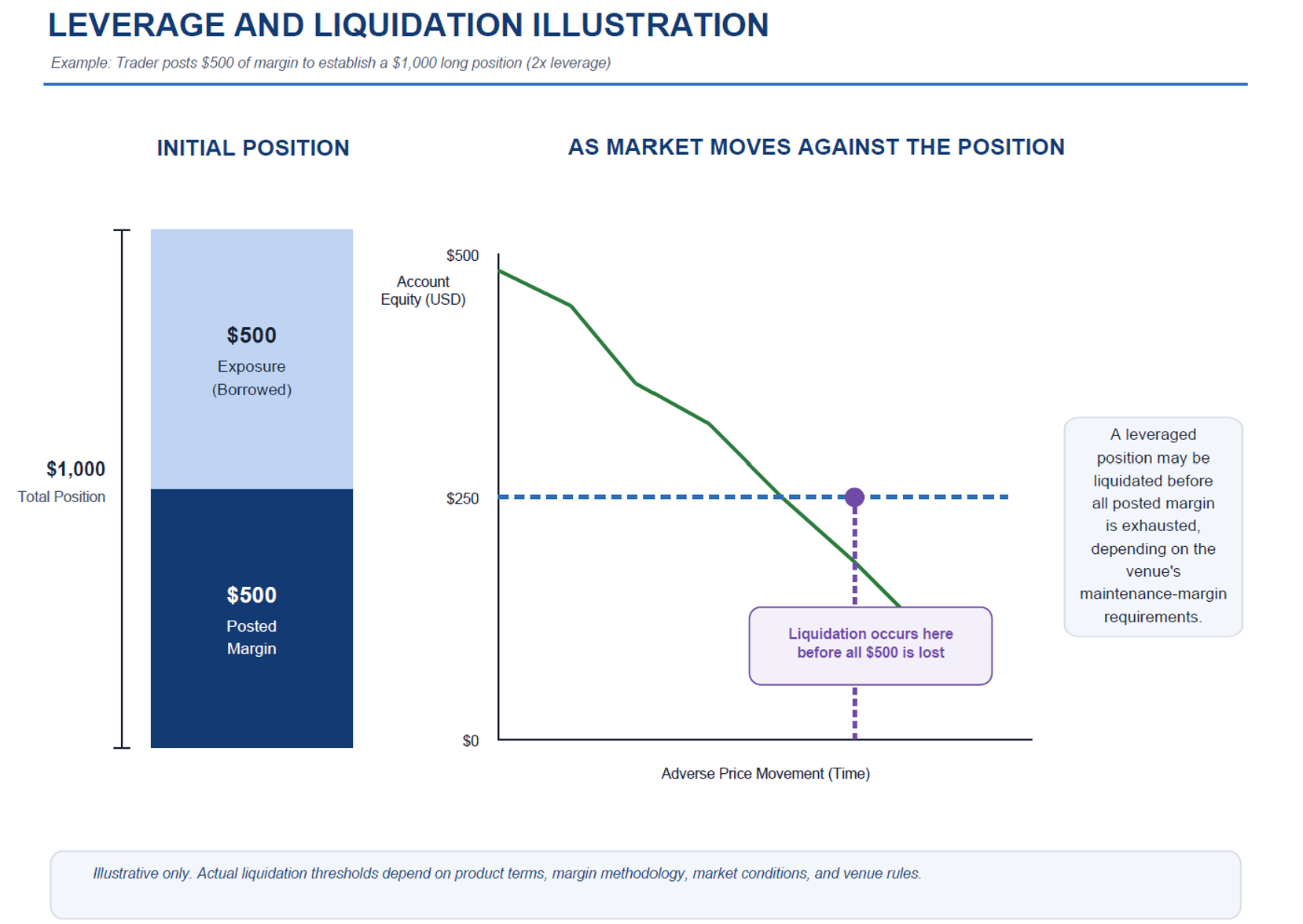
i. Auto-liquidation. Because Perpetuals permit traders to take on leverage without a fixed expiration date, exchanges rely on auto-liquidation as a primary tool for managing the counterparty and default risk that such positions create. Auto-liquidation lets an exchange set margin requirements at which trader positions are automatically closed and the trader’s collateral is applied to cover losses on the position, rather than initiating a margin call.
For example, a trader that posts $500 of margin at 2x leverage, thereby opening a Perpetual position worth $1,000, could have the position auto-liquidated if losses reduce the trader’s remaining margin below the applicable maintenance margin requirement. In practice, that liquidation threshold would generally be reached before the position declines enough to exhaust the full $500 of posted margin.
 |
Auto-liquidation is designed to reduce the risk that losses on an under-margined position will exceed available collateral and affect the trading venue, clearing arrangement or other market participants. It can, however, result in rapid and involuntary closures of positions. A trader whose position is liquidated may not benefit from a subsequent price recovery. Traders may use stop-loss orders or other similar order types to exit a position before it reaches the applicable liquidation threshold. However, stop-loss orders do not guarantee execution at the specified price, particularly in fast-moving or illiquid markets, and they are distinct from margin, liquidation, clearing and default management controls that may be implemented by an exchange.
ii. Insurance funds. Some exchanges maintain insurance funds to address residual losses that remain after liquidation of a defaulting participant’s position. In a typical liquidation process, the exchange first closes the under-margined position and applies the participant’s collateral to cover losses. If there is insufficient collateral to cover the deficit, the insurance fund may be used to absorb the shortfall before losses are allocated to other market participants by way of auto-deleveraging (described below). Insurance funds are intended to protect against exchange-wide deficits, instituting a capital buffer that may be used to absorb residual losses. The size, capitalization and governance of insurance funds vary by venue and are distinct from the default resources required of a CFTC-regulated derivatives clearing organization.
iii. Auto-deleveraging. Auto-deleveraging addresses residual losses that remain after liquidation and any available insurance fund resources are exhausted. In the event of auto-deleveraging, an exchange reduces or closes positions of other market participants, typically profitable traders holding positions opposite the liquidated account, to offset the remaining shortfall. Auto-deleveraging is designed to preserve platform solvency and prevent losses from accumulating at the venue level, but it can also result in involuntary reductions or closures of otherwise profitable positions. The design and frequency vary by venue.
E. Use Cases and Principal Benefits
Market participants use Perpetuals for a variety of purposes that depend on the underlying referenced asset, product structure, and trading venue. Generally, Perpetuals provide synthetic long or short exposure to an underlying asset without buying or selling the asset itself. Because Perpetuals have no scheduled expiration date, they may also serve as a continuous trading instrument for market participants seeking exposure, hedging or arbitrage opportunities without periodically rolling a futures position. Common uses of Perpetuals are set forth below.
- Directional exposure. Traders may use Perpetuals to take long or short positions based on expected price movements in the referenced asset.
- Hedging. Market participants may use Perpetuals to hedge existing exposure to the referenced asset or to a related market.
- Arbitrage. Traders may arbitrage the price difference between the Perpetual market and relevant spot or reference market, including differences reflected in funding rate payments.
Recently, offshore Perpetuals have provided synthetic exposure to private companies expected to go public. For example, in advance of several widely anticipated initial public offerings in 2025 and 2026, offshore venues listed Perpetuals referencing the implied valuations of the relevant pre-IPO companies, and prices in those markets were closely watched as an indication of market valuation for the offerings.
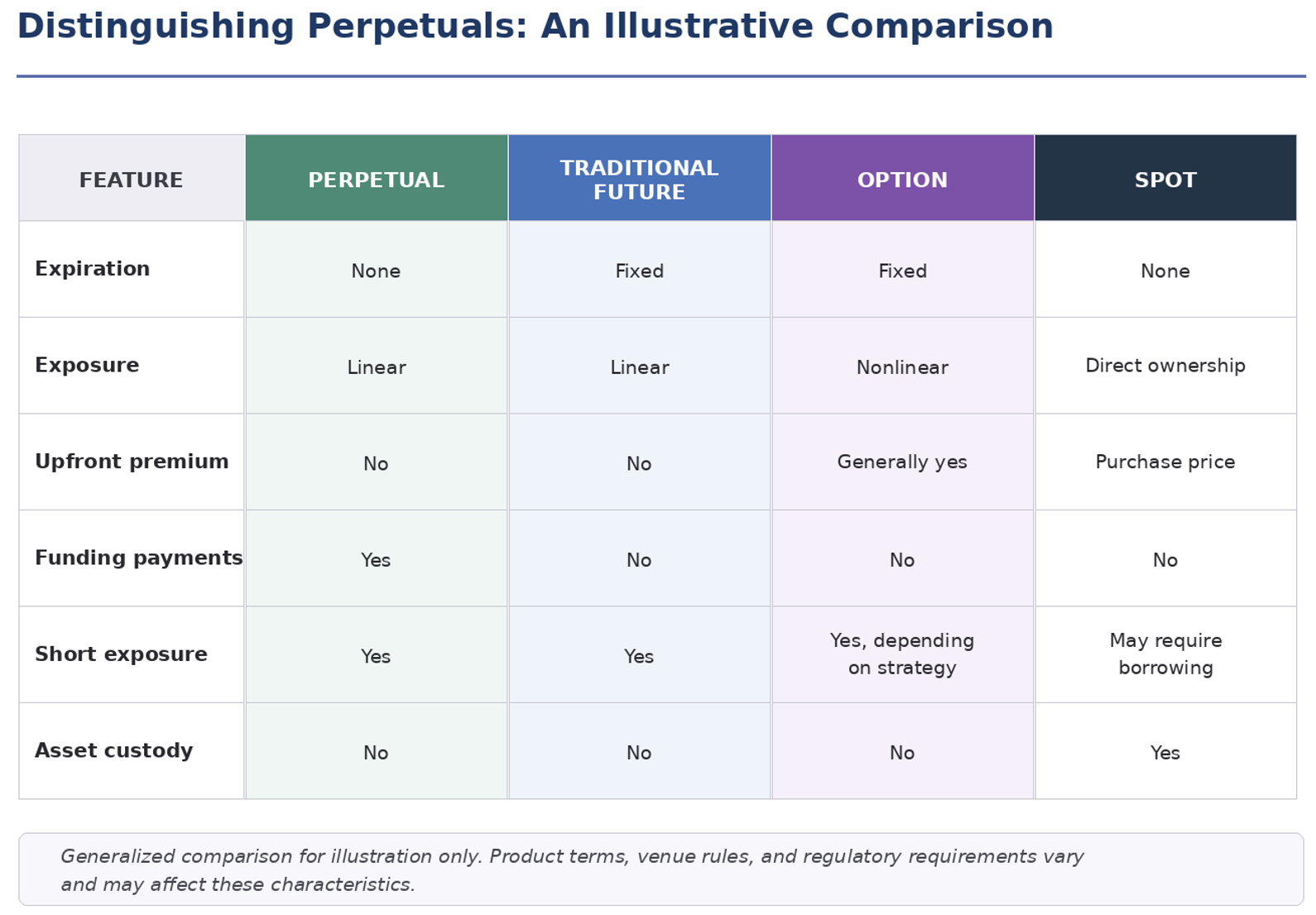
Perpetuals also have features that distinguish them from other financial products. Relative to traditional futures, Perpetuals avoid costs from rolling over or settling expired contracts and concentrate liquidity in one continuous contract. Perpetuals also differ from options in both structure and economics. An option provides the right, but not the obligation, to buy or sell the underlying asset at a specified price, in exchange for an upfront premium, and the value of an option generally erodes as its expiration approaches. A Perpetual, by contrast, provides linear exposure to the price of the underlying asset, involves no upfront premium (although margin must be posted and periodic funding rate payments apply) and has no expiration date. In addition, because options expire, a market participant seeking to maintain continuous exposure through options generally must roll its position into a new contract as each expiration approaches, incurring additional transaction costs, and potentially a new premium payment, with each roll. For market participants seeking continuous directional exposure, a Perpetual may therefore avoid the premium costs, time decay, rolling costs and expiration management associated with maintaining successive options positions. Additionally, compared with spot trading, Perpetuals provide long or short exposure without requiring ownership or custody of the asset itself. Because Perpetuals are typically offered with leverage, they can increase both potential gains and losses.
 |
III. Regulatory Status of Perpetuals
On May 29, 2026, the CFTC issued an Order for Approval (the Kalshi Order) to KalshiEX, LLC (Kalshi), a CFTC-registered DCM, for the listing of the “BTCPERP Contract,” a Perpetual referencing the spot price of bitcoin, as a futures contract. The Kalshi Order also addressed the treatment of “similarly structured” Perpetuals that reference digital commodities with “deep, active, and continuous spot market trading,” as futures contracts. The CFTC determined that such Perpetuals exhibit the characteristics of futures contracts and reasoned that deep, active, broadly distributed and continuously observable spot trading in such assets supports the effective functioning of the funding rate mechanism.[4] Chairman Michael Selig described the approval as a “historic action” and stated that it creates a path for one of the most actively traded segments of the crypto asset markets to operate within the U.S. regulatory framework.[5]
On the same day, the CFTC indicated in a policy statement (the Policy Statement) that all Perpetuals that reference underlying assets outside the scope of the Kalshi Order, such as agricultural products, precious metals, equity securities, and narrow-based security indexes, should be submitted for case-by-case review and approval under CFTC Regulation 40.3 before being listed on a DCM. The CFTC stated that such products may raise novel questions relating to market structure, customer protection, resilience during periods of market stress and consistency with the Core Principles of the Commodity Exchange Act.[6]
The CFTC’s actions also highlight and build on the broader coordination between the CFTC and the U.S. Securities and Exchange Commission (SEC). The report released by the President’s Working Group on Digital Asset Markets in July 2025 (the PWG Report) encouraged the agencies to provide near-term regulatory clarity for innovative derivatives products, and a September 2025 joint statement by the agencies’ leadership identified Perpetuals as a priority area for regulatory harmonization, noting that the agencies could consider concurrent steps to bring onshore Perpetuals that meet investor and customer protection standards.[7] In March 2026, the CFTC and the SEC entered into a Memorandum of Understanding to coordinate their efforts to foster lawful innovation, uphold market integrity and bring novel financial products, including Perpetuals, onshore in the U.S.[8] CFTC Chairman Michael Selig and SEC Chairman Paul Atkins have each publicly supported this objective, with Chairman Selig stating that the CFTC will use the tools at its disposal to bring Perpetuals and other novel derivative products onshore, subject to appropriate safeguards.[9]
Market activity has developed quickly since the Kalshi Order was issued. Kalshi listed the BTCPERP Contract shortly after the Kalshi Order was issued and has since filed self-certifications for additional Perpetuals referencing other digital commodities. Bitnomial Exchange, LLC (Bitnomial) has launched Perpetuals referencing nine digital commodities, including bitcoin, ether and Solana, and Coinbase Derivatives, LLC (Coinbase Derivatives) has announced the conversion of certain existing futures contracts with expiration dates many years—often multiple decades—in the future into Perpetuals with no expiration date in reliance on the no-action relief described below. Market participants have also publicly expressed interest in Perpetuals referencing additional asset classes, such as foreign exchange, precious metals and energy commodities, which, under the Policy Statement, would be subject to case-by-case CFTC review.[10]
The characterization of Perpetuals has also become the subject of litigation. On June 18, 2026, Chicago Mercantile Exchange Inc. filed a complaint in the U.S. District Court for the District of Columbia against the CFTC and Chairman Selig challenging the Kalshi Order and the Policy Statement, arguing that Perpetuals are swaps, not futures, and that the CFTC did not sufficiently address the proper characterization of Perpetuals before approving the BTCPERP Contract. This alert does not address the merits of that litigation, which remains pending as of the date of this publication.[11]
A. Jurisdictional Considerations
The CFTC has jurisdiction over derivatives, including commodity futures, options and swaps. Accordingly, a Perpetual referencing a commodity, including many digital assets, may fall within the CFTC’s jurisdiction if it is structured as a futures contract, option or swap.
The SEC has jurisdiction over securities and security-based swaps, and the CFTC and the SEC share jurisdiction over security futures products, which are futures on a single security or on a narrow-based security index, while futures on a broad-based security index fall within the exclusive jurisdiction of the CFTC.[12] Accordingly, a Perpetual referencing a single security, a narrow-based security index, or another security-linked reference could fall within the SEC’s jurisdiction, the CFTC’s jurisdiction, or both, depending upon the design of the product and statutory classification. The precise allocation of jurisdiction over any particular Perpetual will depend on the classification of the product under these statutory definitions. In the Kalshi Order, the CFTC set out its reasoning for permitting certain Perpetuals referencing digital commodities to be listed by a DCM as futures contracts, and, as discussed below, the CFTC and the SEC have jointly requested public comment on the application of existing statutory definitions to Perpetuals and other innovative products, including whether a cash-settled Perpetual referencing an equity security could be treated as a security futures product. This alert does not address how any particular Perpetual is or should be classified.
B. Regulatory Updates
The following table summarizes the principal CFTC and SEC actions relevant to Perpetuals to date. Certain developments are specific to Perpetuals, such as the CFTC order issued on May 29, 2026 and the CFTC no-action letter issued on June 12, 2026. Other developments, such as those relating to product classification, margining or market structure, apply to the market more generally but are included based on their potential relevance to Perpetuals specifically.
| Date | Development |
| April 21, 2025 | The CFTC requested public comment on the trading and clearing of Perpetuals.[13] |
| May 29, 2026 | The CFTC issued the Kalshi Order[14] and the Policy Statement,[15] and CFTC staff issued interpretive and no-action relief allowing Coinbase Financial Markets, Inc. to offer certain digital asset Perpetuals listed on Deribit FZE, an affiliated foreign board of trade, as “foreign futures” under CFTC Regulation 30.1.[16] |
| June 12, 2026 | CFTC staff issued a no-action letter permitting Bitnomial and Coinbase Derivatives to convert certain existing “perpetual-style” digital commodity futures contracts into Perpetuals by removing their expiration dates, subject to the terms and conditions set out in the Kalshi Order.[17] |
| June 18, 2026 | The CFTC and the SEC jointly requested comment on the clarification and harmonization of the definitions of “swap” and “security-based swap” and related interpretive issues that may be relevant to the characterization of Perpetuals. Comments are due August 24, 2026.[18] |
| June 22, 2026 | The CFTC requested comment on (i) 24/7 trading of standard futures contracts and (ii) Perpetuals referencing physically delivered or storable energy commodities, such as crude oil, signaling that the CFTC is evaluating whether and how Perpetuals beyond digital commodities could be listed in U.S. markets. On July 23, 2026, the CFTC extended the comment deadline from July 27, 2026 to August 26, 2026 and added additional questions for public comment.[19] |
| June 26, 2026 | The CFTC and the SEC jointly requested comment on the harmonization of portfolio margining and cross-margining of securities and derivatives, which, although not specific to Perpetuals, may affect the margining of Perpetuals or portfolios that include them. Comments are due August 31, 2026.[20] |
IV. Conclusion
Perpetuals are increasingly popular financial products that are still finding their place within the U.S. regulatory framework. As of the date of this alert, that framework remains product- and asset-specific: recent CFTC orders, policy statements and staff no-action letters provide a pathway for certain digital commodity Perpetuals to be listed for trading in the U.S., while Perpetuals referencing other asset classes remain subject to a case-by-case analysis by either or both of the CFTC and the SEC. The proper characterization of certain Perpetuals under the federal derivatives and securities laws remains the subject of pending litigation and open requests for public comment. Market participants should continue to monitor CFTC and SEC activity as the regulatory framework for Perpetuals develops. Gibson Dunn’s Derivatives, Fintech and Digital Assets and Financial Regulatory teams are available to assist in any matters relating to Perpetuals and market regulation.
[1] For Perpetuals listed on DCMs to date, funding rates generally have been calculated at one-hour to eight-hour intervals, with the resulting payments applied to positions through the clearing process. By comparison, offshore centralized exchanges commonly use eight-hour funding intervals, although some venues or products use shorter intervals, including four-hour or one-hour intervals, and onchain trading protocols often apply funding even more frequently, in some cases settling payments every hour or accruing funding on an effectively continuous basis. The funding conventions for a particular product are set out in the listing venue’s contract specifications or protocol documentation.
[2] See Robert J. Shiller, Measuring Asset Values for Cash Settlement in Derivative Markets: Hedonic Repeated Measures Indices and Perpetual Futures, 48 J. Fin. 911 (1993).
[3] The risk controls described in this section are principally associated with offshore and onchain trading venues, which generally are not available to U.S. persons. The framework for Perpetuals listed on CFTC-regulated markets is different. A DCM is the CFTC-registered exchange on which a contract is listed and traded: it sets the terms of its listed contracts, establishes margin levels for those products and conducts market and trade practice surveillance. Perpetuals listed on a DCM are cleared through a DCO, a CFTC-registered clearinghouse that stands between the parties to each cleared contract and guarantees its performance, supported by initial and variation margin requirements, daily (and, as applicable, intraday) mark-to-market and prescribed default management procedures backed by a pre-defined waterfall of financial resources. Depending on the market structure, customers may access a DCM through a futures commission merchant (an FCM, which collects margin from its customers and must hold customer funds in segregated accounts) or, on non-intermediated venues, as direct participants. Under-margined positions on these markets are generally addressed through margin calls and, if a margin call is not met, liquidation of the position by the FCM in accordance with the customer agreement and applicable rules, or through liquidation procedures set out in the exchange’s and clearinghouse’s rulebooks, rather than through the discretionary insurance funds or auto-deleveraging mechanisms described above. DCMs and DCOs are also subject to statutory core principles and CFTC regulations addressing, among other things, position limits or position accountability levels, price fluctuation limits, minimum financial resource requirements and customer protections.
[4] See In re Request for Approval by KalshiEX LLC of the BTCPERP Futures Contract, Order Approving KalshiEX LLC BTCPERP Futures Contract (CFTC May 29, 2026), https://www.cftc.gov/filings/documents/2026/orgdcmkexbtxperporder26601.pdf (“Order for Approval”).
[5] See Michael S. Selig, Chairman, CFTC, Statement Regarding the Approval of the BTCPERP Contract, Release No. 9240-26 (May 29, 2026), https://www.cftc.gov/PressRoom/PressReleases/9240-26; see also Michael S. Selig, What American crypto asset perpetuals mean for the future of crypto, CoinDesk (May 29, 2026), https://www.coindesk.com/opinion/2026/05/29/what-american-crypto-asset-perpetuals-mean-for-the-future-of-crypto.
[6] See CFTC, Policy Statement Concerning the Listing of Perpetual Contracts, Release No. 9242-26 (May 29, 2026), 91 Fed. Reg. 33160 (June 3, 2026) (“May 29 Policy Statement”).
[7] See President’s Working Group on Digital Asset Markets, Strengthening American Leadership in Digital Financial Technology (July 30, 2025), https://www.whitehouse.gov/wp-content/uploads/2025/07/Digital-Assets-Report-EO14178.pdf; Paul S. Atkins & Caroline D. Pham, Joint Statement from the Chairman of the SEC and Acting Chairman of the CFTC (Sept. 5, 2025), https://www.sec.gov/newsroom/speeches-statements/joint-statement-atkins-pham-090525. For additional information regarding the PWG Report, see our prior publication, Update on the U.S. Digital Assets Regulatory Framework – Market Structure, Banking, Payments, and Taxation (Aug. 5, 2025), https://www.gibsondunn.com/update-on-the-us-digital-assets-regulatory-framework-market-structure-banking-payments-and-taxation/.
[8] See CFTC & SEC, Memorandum of Understanding between the U.S. Securities and Exchange Commission and the U.S. Commodity Futures Trading Commission regarding Harmonization in Areas of Common Regulatory Interest, Release No. 9192-26 (Mar. 11, 2026), https://www.cftc.gov/media/13471/SEC_CFTC_MOU031126/download.
[9] See Michael S. Selig, Chairman, CFTC, The Next Phase of Project Crypto: Unleashing Innovation for the New Frontier of Finance (Jan. 29, 2026), https://www.cftc.gov/PressRoom/SpeechesTestimony/opaselig1.
[10] See, e.g., Anirban Sen, Exclusive: Kalshi in Talks with Regulators to Expand Never-Expiring Derivatives to New Areas, Reuters (July 9, 2026), https://www.reuters.com/business/finance/kalshi-talks-with-regulators-expand-never-expiring-derivatives-new-areas-2026-07-09 ; KalshiEX LLC, Commission Regulation 40.3(a), Voluntary Submission of New Products for Commission Review and Approval Regarding the Initial Listing of the GOLDPERP Futures Contract (July 21, 2026), https://www.cftc.gov/filings/ptc/ptc07212611017.pdf; KalshiEX LLC, Commission Regulation 40.3(a), Voluntary Submission of New Products for Commission Review and Approval Regarding the Initial Listing of the SILVERPERP Futures Contract (July 21, 2026), https://www.cftc.gov/filings/ptc/ptc07212611023.pdf; KalshiEX LLC, Commission Regulation 40.3(a), Voluntary Submission of New Products for Commission Review and Approval Regarding the Initial Listing of the PLATINUMPERP Futures Contract (July 21, 2026), https://www.cftc.gov/filings/ptc/ptc07212611030.pdf; CFTC, Request for Comment on the Extension of Standard Futures Contracts to 24/7 Trading and on Perpetual Contracts Referencing Physically Delivered or Storable Energy Commodities, Release No. 9259-26 (June 22, 2026), 91 Fed. Reg. 38334 (June 25, 2026) (“Extension RFC”); May 29 Policy Statement, supra note 6.
[11] See Complaint, Chi. Mercantile Exch. Inc. v. Selig, No. 1:26-cv-02157 (D.D.C. June 18, 2026), ECF No. 1.
[12] See 7 U.S.C. § 2(a)(1)(D); 15 U.S.C. § 78c(a)(55) (security futures and security futures products); 7 U.S.C. §§ 2(a)(1)(A), 2(a)(1)(C)(ii) (futures on broad-based security indexes).
[13] See CFTC, Request for Comment on the Trading and Clearing of “Perpetual” Style Derivatives, Release No. 9069-25 (Apr. 21, 2025), https://www.cftc.gov/media/12041/Perpetuals_RFC042125/download.
[14] See Order for Approval, supra note 4.
[15] See May 29 Policy Statement, supra note 6.
[16] See CFTC, Staff Interpretation Regarding the Categorization of Deribit Perpetuals as Foreign Futures and No-Action Position Regarding Digital Commodities and Payment Stablecoins Deposited to Margin Customer Positions with a Foreign Broker Under a Right of Re-Use (No-Action Letter), Release No. 9241-26 (May 29, 2026), https://www.cftc.gov/csl/26-17/download.
[17] See CFTC, No-Action Positions Regarding Removal of Expiration Dates from Existing Digital Commodity Perpetual-Style Futures Contracts (No-Action Letter), Release No. 9252-26 (June 12, 2026), https://www.cftc.gov/csl/26-19/download.
[18] See CFTC & SEC, Joint Request for Comment on Further Definition of “Swap” and “Security-Based Swap” and on Alternative Compliance (Request for Comment), Release No. 9258-26 (June 18, 2026), 91 Fed. Reg. 37873 (June 24, 2026).
[19] See Extension RFC, supra note 10. The comment period was subsequently extended to August 26, 2026, and additional questions were posed for public comment. See Press Release, CFTC, CFTC Extends Public Comment Period on Proposed Rule on the Extension of Standard Futures Contracts to 24/7 Trading and on Perpetual Contracts Referencing Physically Delivered or Storable Energy Commodities (July 23, 2026), https://www.cftc.gov/PressRoom/PressReleases/9271-26.
[20] See CFTC & SEC, Joint Request for Comment on Further Implementation of Portfolio Margining and Cross-Margining of Securities and Derivatives (Request for Comment), Release No. 9262-26 (June 26, 2026), 91 Fed. Reg. 39579 (June 30, 2026).
Gibson Dunn’s lawyers are available to assist with any questions you may have regarding these developments. To learn more, please contact the Gibson Dunn lawyer with whom you usually work, any leader or member of the firm’s Derivatives, Securities Regulation & Corporate Governance, Fintech & Digital Assets, Financial Institutions, Financial Regulatory, or Administrative Law & Regulatory practice groups, or the following authors:
Mellissa Campbell Duru – Washington, D.C. (+1 202.955.8204, mduru@gibsondunn.com)
Marian Fowler – Washington, D.C. (+1 202.955.8525, mfowler@gibsondunn.com)
Matt Gregory – Washington, D.C. (+1 202.887.3635, mgregory@gibsondunn.com)
William R. Hallatt – Hong Kong (+852 2214 3836, whallatt@gibsondunn.com)
Nick Harper – Washington, D.C. (+1 202.887.3534, nharper@gibsondunn.com)
Lauren Cook Jackson – Washington, D.C. (+1 202.955.8293, ljackson@gibsondunn.com)
Sameera Kimatrai – Dubai (+971 4 318 4616, skimatrai@gibsondunn.com)
Michelle M. Kirschner – London (+44 20 7071 4212, mkirschner@gibsondunn.com)
Hagen H. Rooke – Singapore (+65 6507 3620, hhrooke@gibsondunn.com)
Jeffrey L. Steiner – Washington, D.C. (+1 202.887.3632, jsteiner@gibsondunn.com)
Sara K. Weed – Washington, D.C. (+1 202.955.8507, sweed@gibsondunn.com)
Attorney Advertising: These materials were prepared for general informational purposes only based on information available at the time of publication and are not intended as, do not constitute, and should not be relied upon as, legal advice or a legal opinion on any specific facts or circumstances. Gibson Dunn (and its affiliates, attorneys, and employees) shall not have any liability in connection with any use of these materials. The sharing of these materials does not establish an attorney-client relationship with the recipient and should not be relied upon as an alternative for advice from qualified counsel. Please note that facts and circumstances may vary, and prior results do not guarantee a similar outcome.
The post Perpetual Contracts: Product Structure and Recent U.S. Regulatory Developments appeared first on Gibson Dunn.